
16 Sep Biostatistics boost for Zimbabwe as mentorship delivers TB prediction model
Mathematics was her “go to” subject at school, muses biostatistician Mildred Pepukai, “because you don’t have to spell anything”.
Her aptitude for numbers has taken Mildred far in life: first from collecting data in the field to analysing it; from a bachelor’s degree in applied science to a master’s in biostatistics and soon a PhD in mathematics and statistics, and now thousands of kilometres from her home in Harare, Zimbabwe.
She sits in the dining room of the Amsterdam Institute for Global Health and Development following two weeks of in-person mentorship from two AIGHD Senior Fellows, Prof. Frank Cobelens and Dr. Daniella Brals. Mildred is buzzing because the data model she came to develop is working.
“I didn’t want to leave without a model that’s running and it being clear to me what it’s doing so that I can make modifications,” she explains.
Mildred is conducting a secondary analysis of data collected in Harare, Cape Town, Lusaka, and Maputo as part of the XACT 3 study to test a new approach for identifying active TB cases. She wants to pinpoint the characteristics of people more likely to develop TB – and what their communities are like – so interventions can be better targeted. While in Amsterdam, Mildred was working with preliminary data, but she will receive the full dataset to complete the analysis, which will include teasing out the impact of diabetes.
“Already, the data is showing that people who have malnutrition and smoke have two to three times the chance of developing active TB,” she says.
‘Protected time’ to strengthen research skills
Mildred’s chance to immerse herself in a meaty biostatistics project came thanks to the third TESA (Trial of Excellence in Southern Africa) project. Funded by the European & Developing Countries Clinical Trials Partnership (EDCTP), TESA III is dedicated to developing, strengthening, and expanding clinical research skills in southern Africa.
The plan is to publish a paper about her study (the working title is “Multilevel Determinants of Tuberculosis in High-Burden, Resource-Limited Settings: A Bayesian Analysis”) and present the results at the World Conference on Lung Health.
As any working parent would know, it’s tricky to fully immerse yourself in an after-hours project when your brood must be fed, cleaned, and supervised. Mildred’s 9-year-old daughter and 7-year-old son stayed with her mom in Harare while she travelled to the Netherlands.
“This visit was good for me because it was protected time,” Mildred says. “Since my children are so close together in ages, it’s like I’m a call centre – it’s one complaint after the other. Sometimes I have to be a referee. Sometimes I have to be a judge. Sometimes I have to be the counsellor who brings them back together.” She smiles. “But I’m excited to return and get back on that whole rollercoaster!”
Prof. Cobelens says Mildred’s visit was “an essential part” of the mentorship. “The intent is to broaden Mildred’s statistical toolkit and enable her to advise researchers and institutions on more advanced statistical methods to use. It also benefits her institute since they now have someone capable of carrying out these kinds of analyses.”
-

- Mildred Pepukai, who works as a project manager at the Biomedical Research and Training Institute in Zimbabawe, with her mentor, AIGHD Senior Fellow Prof. Frank Cobelens.
-

- Mildred with her son and daughter.

-
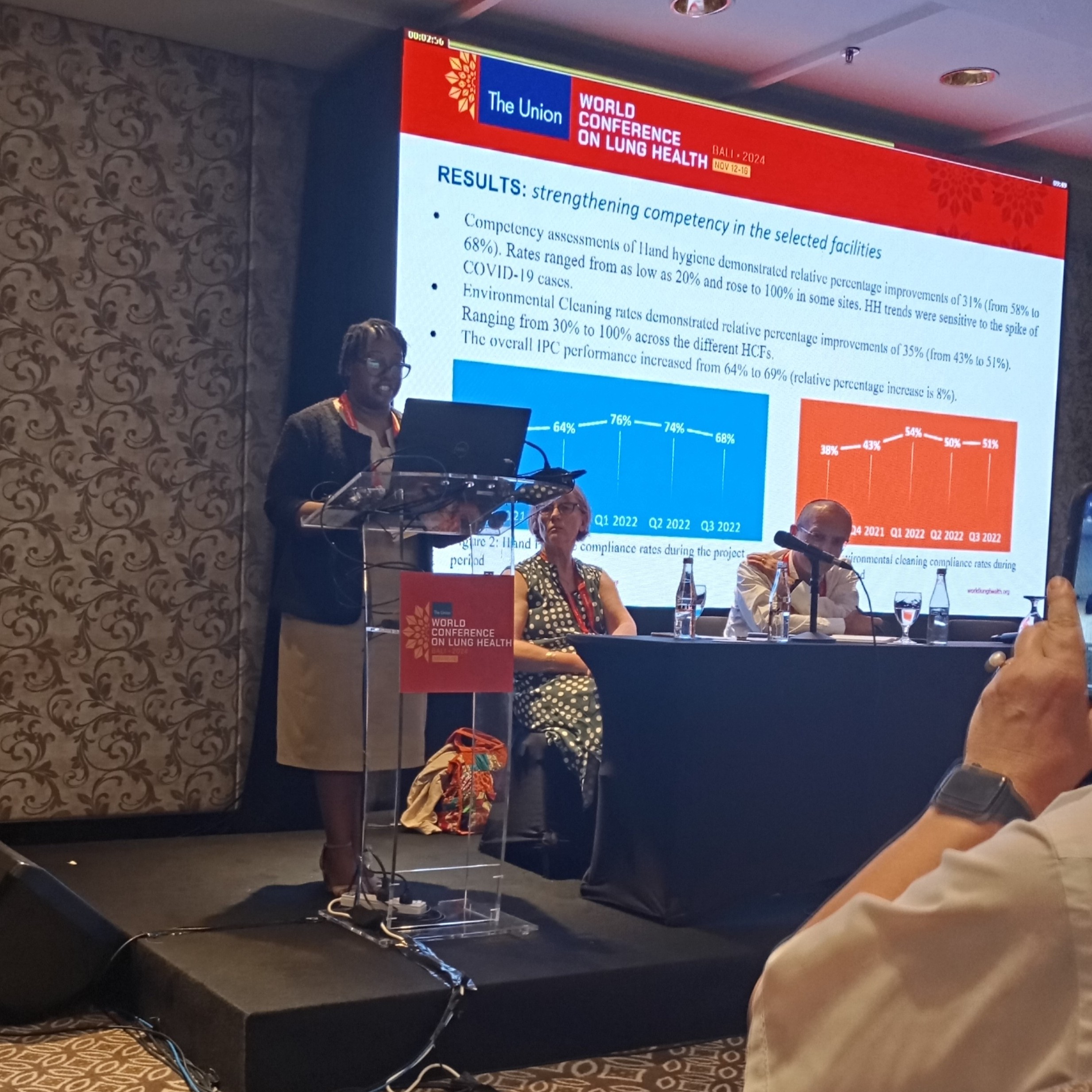
- Mildred presenting at the World Conference on Lung Health in 2024.