
09 Feb Master’s internship on TB risk in Africa leads to paper as first author
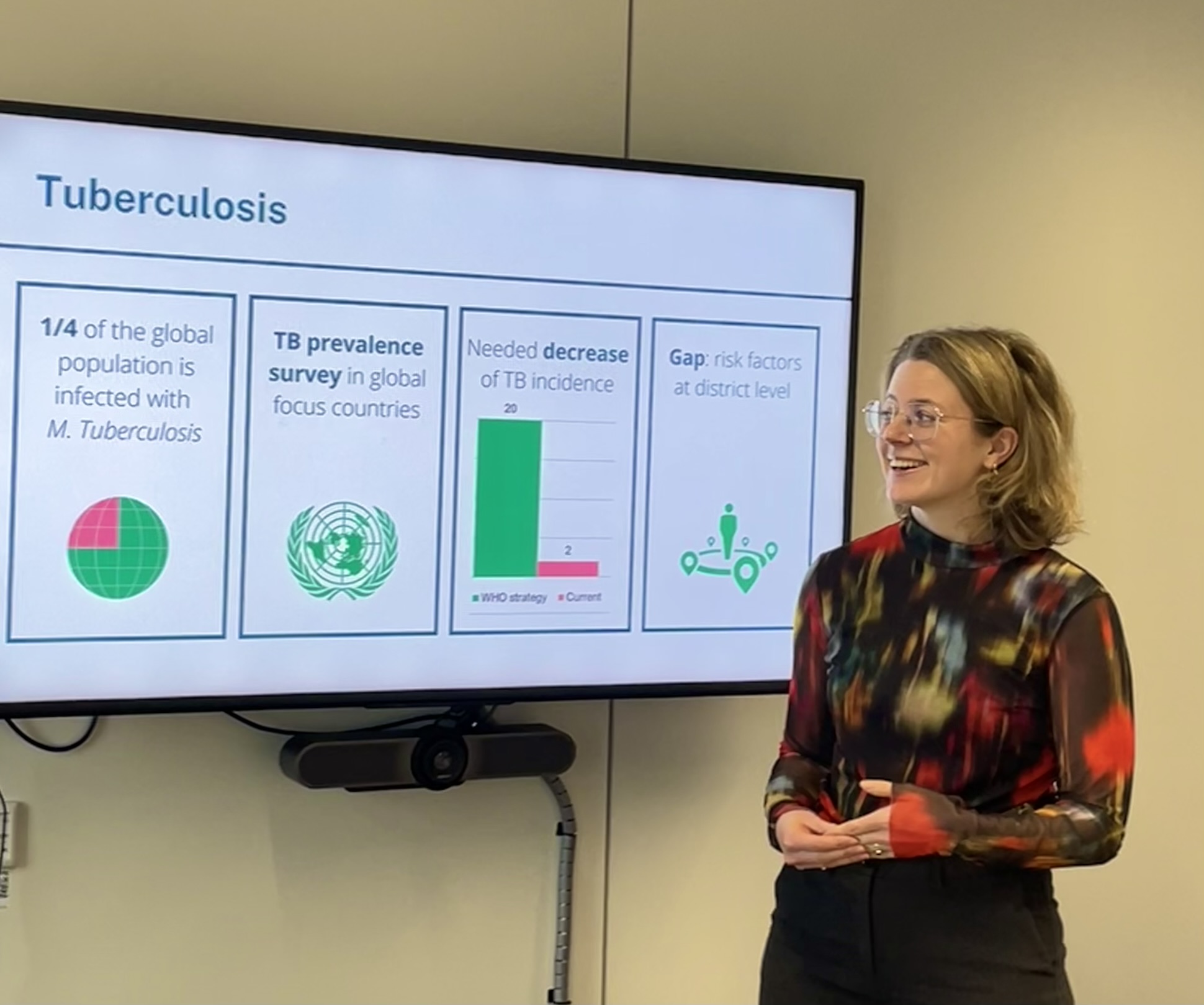
Research for a master’s internship at AIGHD has just appeared in the venerable eClinicalMedicine, one of The Lancet’s Discovery Science journals. First author Tessa Haverkate charted the environmental and demographic risk factors for contracting tuberculosis (TB) in seven African countries.
She found that latitude, urban settings, and higher population density were associated with an increased risk of TB, whereas altitude above 900 m, rainfall between 50 and 100 mm annually, and higher temperatures were associated with a decreased prevalence. Fine particulate matter, solar radiation, and the International Wealth Index showed no significant associations.
Haverkate completed the analysis as part of her master’s degree in global health research, working under the guidance of Prof. Frank Cobelens, Dr Daniela Brals, and Dr Logan Stuck. Over time, Stuck had gathered the full datasets of nationally representative surveys on TB prevalence carried out between 2012 and 2019.
The paper was based on the surveys conducted in Ghana, Lesotho, Nigeria, South Africa, Sudan, Uganda, and Zambia. Haverkate supplemented it with publicly accessible data on environmental factors.
“At the start of my internship, my interest in environmental and planetary health was really starting to grow,” explains Haverkate. “This dataset, which covered multiple countries and over 300,000 participants, felt like a rare chance to explore that angle in a meaningful way. What began as a master’s project slowly evolved into a full publication, expanding along the way with additional variables and questions.”
One challenging aspect was matching up the administrative names of districts, counties, and provinces, as the spelling often differed.
“It was like a puzzle,” says Haverkate, who is now pursuing a PhD at the Erasmus MC. “I spent so much time on Google Maps and digging into the geographical history of the countries to figure out which district was which, but it was unexpectedly fun.”
She was especially pleased that the direction and the magnitude of the results proved stable in the sensitivity analysis. “It really adds to the growing evidence that there is more to TB than individual or social determinants. These environmental determinants are part of the story, and not just something that happens in the background.”
Cobelens – professor of global health at the University of Amsterdam and Senior Fellow at AIGHD – says Haverkate’s work could prove helpful for tuberculosis control efforts. “There is a higher risk of TB in colder areas, and Tessa has shown that the risk is also associated with population density and being in an urban area. This has always been said, but it has hardly ever been proven so clearly.”
Read the full paper online: Environmental-demographic determinants associated with tuberculosis prevalence in seven African countries: an aggregated dataset analysis.